Social Media as a Micro-Ecosystem for Community-Based E-Learning: A Systematic Review
DOI:
https://doi.org/10.51903/twpgeq37Keywords:
Community-based learning, Digital literacy, E-learning, Micro-ecosystem, Social mediaAbstract
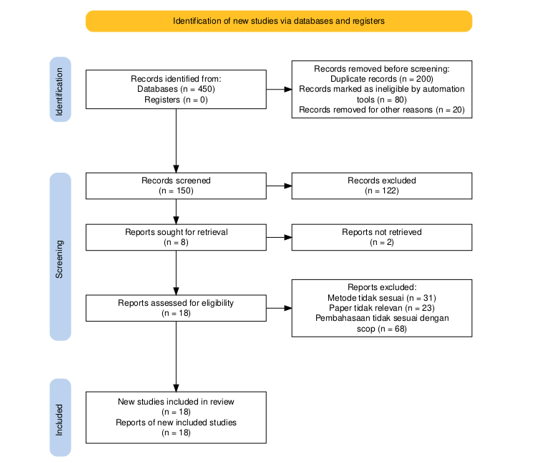
The integration of social media into digital education has transformed how communities engage in collaborative learning. While social media platforms were initially designed for communication, they have evolved into micro-ecosystems that support community-based e-learning. This study conducts a Systematic Literature Review (SLR) to examine the role of social media as a micro-ecosystem in enhancing collaborative learning environments. Using the PRISMA protocol, 450 articles were initially identified from Scopus, Web of Science, IEEE Xplore, and Google Scholar. After multiple screening stages, 80 articles met the inclusion criteria and were analyzed in-depth. The findings indicate that platforms such as WhatsApp, Facebook, YouTube, and Edmodo significantly enhance learning engagement, collaboration, and knowledge sharing. Specifically, student engagement increased by up to 40% compared to traditional LMS-based methods, with satisfaction rates exceeding 80% among Edmodo users. Moreover, WhatsApp communities achieved a message open rate of 98%, demonstrating high responsiveness and interaction quality. However, challenges such as low digital literacy, data privacy concerns, and distractions from non-academic content were also identified. This research contributes a comprehensive synthesis of how social media can function as a micro-ecosystem to foster inclusive, flexible, and community-driven learning. It also offers strategic recommendations for educators and policymakers to optimize the use of social platforms for education in the digital era.
References
Allasiw, D. I., Tanaka, T., Kudo, S., & Mino, T. (2023). Opportunities and limitations to social learning for sustainability: empirical insights from a participatory approach to community-based resource management in the Philippines. International Journal of Agricultural Sustainability, 21(1). https://doi.org/10.1080/14735903.2023.2239075
Belur, J., Tompson, L., Thornton, A., & Simon, M. (2021). Interrater Reliability in Systematic Review Methodology: Exploring Variation in Coder Decision-Making. Sociological Methods and Research, 50(2), 837–865. https://doi.org/10.1177/0049124118799372
Colpitts, B. D. F., Smith, M. D., & McCurrach, D. P. (2021). Enhancing the digital capacity of EFL programs in the age of COVID-19: the ecological perspective in Japanese higher education. Interactive Technology and Smart Education, 18(2), 158–174. https://doi.org/10.1108/ITSE-08-2020-0123
D Imamyartha, E Wahjuningsih, & A A’yunin. (2022). EFL learners’ engagement and learning motivation in team-based mobile language learning through WhatsApp. Teaching English with Technology, 22(1), 82–103. https://doi.org/http://www.tewtjournal.org
Díaz Redondo, R. P., Caeiro Rodríguez, M., López Escobar, J. J., & Fernández Vilas, A. (2021). Integrating micro-learning content in traditional e-learning platforms. Multimedia Tools and Applications, 80(2), 3121–3151. https://doi.org/10.1007/s11042-020-09523-z
Dwivedi, Y. K., Ismagilova, E., Hughes, D. L., Carlson, J., Filieri, R., Jacobson, J., Jain, V., Karjaluoto, H., Kefi, H., Krishen, A. S., Kumar, V., Rahman, M. M., Raman, R., Rauschnabel, P. A., Rowley, J., Salo, J., Tran, G. A., & Wang, Y. (2021). Setting the future of digital and social media marketing research: Perspectives and research propositions. International Journal of Information Management, 59, 102168. https://doi.org/10.1016/J.IJINFOMGT.2020.102168
Heinrich, E., Thomas, H., & Kahu, E. R. (2022). An exploration of course and cohort communication spaces in Discord, Teams, and Moodle. Australasian Journal of Educational Technology, 38(6), 107–120. https://doi.org/10.14742/ajet.7633
Ismail SN, Hamid S, & M Ahmad. (2021). Exploring students engagement towards the learning management system (LMS) using learning analytics. Cdn.Techscience.Cn, 37(1), 74–87. https://doi.org/10.32604/csse.2021.015261
Jacobs, M. S., George, F., & Anga’ama, D. (2023). Online learning and peer support: Exploring the use of WhatsApp in first-year mathematics. Pythagoras, 44(1), 1–9. https://doi.org/10.4102/Pythagoras.V44I1.716
Jenkins, E. L., Brennan, L., Molenaar, A., & McCaffrey, T. A. (2022). Exploring the application of social media in food waste campaigns and interventions: A systematic scoping review of the academic and grey literature. Journal of Cleaner Production, 360, 132068. https://doi.org/10.1016/J.JCLEPRO.2022.132068
K Sriwisathiyakun, & Dhamanitayakul C. (2022). Enhancing digital literacy with an intelligent conversational agent for senior citizens in Thailand. Education and Information Technologies, 27(5), 6251–6271. https://doi.org/10.1007/s10639-021-10862-z
Kalam, A., Goi, C. L., & Tiong, Y. Y. (2023). Student motivations for social media use and their effects on academic performance- a meditational approach in emerging market. Interactive Technology and Smart Education, 20(3), 313–334. https://doi.org/10.1108/ITSE-09-2022-0115/FULL/XML
Khan, M. N., Ashraf, M. A., Seinen, D., Khan, K. U., & Laar, R. A. (2021). Social Media for Knowledge Acquisition and Dissemination: The Impact of the COVID-19 Pandemic on Collaborative Learning Driven Social Media Adoption. Frontiers in Psychology, 12, 648253. https://doi.org/10.3389/FPSYG.2021.648253/BIBTEX
König, J., Santagata, R., Scheiner, T., Adleff, A. K., Yang, X., & Kaiser, G. (2022). Teacher noticing: A systematic literature review of conceptualizations, research designs, and findings on learning to notice. Educational Research Review, 36, 100453. https://doi.org/10.1016/J.EDUREV.2022.100453
Kordzadeh, N., & Ghasemaghaei, M. (2021). Algorithmic bias: review, synthesis, and future research directions. European Journal of Information Systems, 31(3), 388–409. https://doi.org/10.1080/0960085X.2021.1927212
Krismanto, W., Setyosari, P., Kuswandi, D., & Praherdhiono, H. (2022). Social Media-Based Professional Learning: What Are Teachers Doing in It? Qualitative Research in Education, 11(1), 89–116. https://doi.org/10.17583/QRE.9698
Kropczynski, J., Aljallad, Z., Elrod, N. J., Lipford, H., & Wisniewski, P. J. (2021). Towards Building Community Collective Efficacy for Managing Digital Privacy and Security within Older Adult Communities. Proceedings of the ACM on Human-Computer Interaction, 4(CSCW3). https://doi.org/10.1145/3432954
Kumar, A., Krishnamurthi, R., Bhatia, S., Kaushik, K., Ahuja, N. J., Nayyar, A., & Masud, M. (2021). Blended Learning Tools and Practices: A Comprehensive Analysis. IEEE Access, 9, 85151–85197. https://doi.org/10.1109/ACCESS.2021.3085844
Lampropoulos, G., Barkoukis, V., Burden, K., & Anastasiadis, T. (2021). 360-degree video in education: An overview and a comparative social media data analysis of the last decade. Smart Learning Environments, 8(1), 1–24. https://doi.org/10.1186/S40561-021-00165-8/TABLES/13
Lee, C.-S., & Yew, L.-Y. (2022). Enhancing Customer Satisfaction through Open Innovation Communities: A Comparison of Knowledge Management Approaches. Knowledge Management & E-Learning, 14(1), 81–102. https://doi.org/10.34105/j.kmel.2022.14.006
Lee, K. J., Tilling, K. M., Cornish, R. P., Little, R. J. A., Bell, M. L., Goetghebeur, E., Hogan, J. W., & Carpenter, J. R. (2021). Framework for the treatment and reporting of missing data in observational studies: The Treatment And Reporting of Missing data in Observational Studies framework. Journal of Clinical Epidemiology, 134, 79–88. https://doi.org/10.1016/J.JCLINEPI.2021.01.008
Li, L. (2022). Reskilling and Upskilling the Future-ready Workforce for Industry 4.0 and Beyond. Information Systems Frontiers, 1–16. https://doi.org/10.1007/S10796-022-10308-Y/FIGURES/1
Liang, A. R. Da. (2022). Consumers as co-creators in community-based tourism experience: Impacts on their motivation and satisfaction. Cogent Business & Management, 9(1). https://doi.org/10.1080/23311975.2022.2034389
Lim, M. S. C., Molenaar, A., Brennan, L., Reid, M., & McCaffrey, T. (2022). Young Adults’ Use of Different Social Media Platforms for Health Information: Insights From Web-Based Conversations. Journal of Medical Internet Research, 24(1), e23656. https://doi.org/10.2196/23656
Maquera, G., da Costa, B. B. F., Mendoza, Ó., Salinas, R. A., & Haddad, A. N. (2022). Intelligent Digital Platform for Community-Based Rural Tourism—A Novel Concept Development in Peru. Sustainability 2022, Vol. 14, Page 7907, 14(13), 7907. https://doi.org/10.3390/SU14137907
Nacheva R, J. A. (2022). Current Perspectives in Social Media Supported E-Learning. Academia.Edu, 10(1), 71–86. https://doi.org/10.22364/bjmc.2022.10.1.05
Perifanou, M., Tzafilkou, K., & Economides, A. A. (2021). The Role of Instagram, Facebook, and YouTube Frequency of Use in University Students’ Digital Skills Components. Education Sciences 2021, Vol. 11, Page 766, 11(12), 766. https://doi.org/10.3390/EDUCSCI11120766
Pimmer, C., Brühlmann, F., Odetola, T. D., Dipeolu, O., Oluwasola, O., Jäger, J., & Ajuwon, A. J. (2021). WhatsApp for mobile learning. Effects on knowledge, resilience and isolation in the school-to-work transition. The Internet and Higher Education, 50, 100809. https://doi.org/10.1016/J.IHEDUC.2021.100809
Pokrovskaia, N. N., Leontyeva, V. L., Ababkova, M. Y., Cappelli, L., & D’ascenzo, F. (2021). Digital Communication Tools and Knowledge Creation Processes for Enriched Intellectual Outcome—Experience of Short-Term E-Learning Courses during Pandemic. Future Internet 2021, Vol. 13, Page 43, 13(2), 43. https://doi.org/10.3390/FI13020043
Pye, S., Broad, O., Bataille, C., Brockway, P., Daly, H. E., Freeman, R., Gambhir, A., Geden, O., Rogan, F., Sanghvi, S., Tomei, J., Vorushylo, I., & Watson, J. (2021). Modelling net-zero emissions energy systems requires a change in approach. Climate Policy, 21(2), 222–231. https://doi.org/10.1080/14693062.2020.1824891
Rethlefsen, M. L., Kirtley, S., & Waffenschmidt, S. (2021). PRISMA-S: an extension to the PRISMA Statement for Reporting Literature Searches in Systematic Reviews. Systematic Reviews, 10(1), 1–19. https://doi.org/10.1186/s13643-020-01542-z
Romsi A, Widodo JP, & J Slamet. (2024). Empowering Slow Learners: Gamification’s Impact on Students’ Engagement and Academic Performance in an LMS for Undergraduate Students. Ijiet.Org, 14(2), 193–203. https://doi.org/doi:10.18178/ijiet.2024.14.2.2040
Shahzad, K., Khan, S. A., Javed, Y., & Iqbal, A. (2023). E-Learning for Continuing Professional Development of University Librarians: A Systematic Review. Sustainability 2023, Vol. 15, Page 849, 15(1), 849. https://doi.org/10.3390/SU15010849
Song, J. S., Ngnouwal Eloundou, G., Bitoto Ewolo, F., & Ondoua Beyene, B. (2024). Does Social Media Contribute to Economic Growth? Journal of the Knowledge Economy, 15(2), 8349–8389. https://doi.org/10.1007/S13132-023-01419-1/TABLES/12
Sujarwoto, Saputri, R. A. M., & Yumarni, T. (2023). Social Media Addiction and Mental Health Among University Students During the COVID-19 Pandemic in Indonesia. International Journal of Mental Health and Addiction, 21(1), 96–110. https://doi.org/10.1007/S11469-021-00582-3/TABLES/4
Swart, J. (2021). Tactics of news literacy: How young people access, evaluate, and engage with news on social media. Sage Journals, 25(3), 505–521. https://doi.org/10.1177/14614448211011447
Thomas, R. L., Alabraba, V., Barnard, S., Beba, H., Brake, J., Cox, A., Bowker, R., Edwards, D., Epps, A., Fletcher-Salt, T., Holmes, P., Kar, P. S., Kausar, N., Kelly, B., Leveridge, M., Newland-Jones, P., Ng, S. M., Puttana, A., & Stewart, R. (2023). Use of Social Media as a Platform for Education and Support for People With Diabetes During a Global Pandemic. Journal of Diabetes Science and Technology, 17(2), 353–363. https://doi.org/10.1177/19322968211054862
Ü Avci, & A Kula. (2023). Examining the predictors of university students’ engagement, fear of missing out and Internet addiction in online environments. Information Technology and People, 36(7), 0959–3845. https://doi.org/10.1108/ITP-05-2021-0416
Ulla, M. B., & Perales, W. F. (2021). Facebook as an integrated online learning support application during the COVID19 pandemic: Thai university students’ experiences and perspectives. Heliyon, 7(11). https://doi.org/10.1016/j.heliyon.2021.e08317
V H Solana, Castro, & C C. (2022). Telegram Channels and Bots: A Ranking of Media Outlets Based in Spain. Societies 2022, Vol. 12, Page 164, 12(6), 164. https://doi.org/10.3390/SOC12060164
van de Merwe, K., Mallam, S., & Nazir, S. (2024). Agent Transparency, Situation Awareness, Mental Workload, and Operator Performance: A Systematic Literature Review. Human Factors, 66(1), 180–208. https://doi.org/10.1177/00187208221077804
Vornholt, P., & De Choudhury, M. (2021). Understanding the Role of Social Media-Based Mental Health Support Among College Students: Survey and Semistructured Interviews. JMIR Mental Health, 8(7), e24512. https://doi.org/10.2196/24512
Wang, X., & Zhang, W. (2022). Improvement of Students’ Autonomous Learning Behavior by Optimizing Foreign Language Blended Learning Mode. SAGE Open, 12(1). https://doi.org/10.1177/21582440211071108
Wijermars, M., & Lokot, T. (2022). Is Telegram a “harbinger of freedom”? The performance, practices, and perception of platforms as political actors in authoritarian states. Post-Soviet Affairs, 38(1–2), 125–145. https://doi.org/10.1080/1060586X.2022.2030645
Xie, L., Pinto, J., & Zhong, B. (2022). Building community resilience on social media to help recover from the COVID-19 pandemic. Computers in Human Behavior, 134, 107294. https://doi.org/10.1016/J.CHB.2022.107294
Zamiri, M., & Esmaeili, A. (2024). Strategies, Methods, and Supports for Developing Skills within Learning Communities: A Systematic Review of the Literature. Administrative Sciences 2024, Vol. 14, Page 231, 14(9), 231. https://doi.org/10.3390/admsci14090231
Zeydani, A., Atashzadeh-Shoorideh, F., Abdi, F., Hosseini, M., Zohari-Anboohi, S., & Skerrett, V. (2021). Effect of community-based education on undergraduate nursing students’ skills: a systematic review. BMC Nursing, 20(1), 1–12. https://doi.org/10.1186/s12912-021-00755-4
Zheng, X., Ismail, S. M., & Heydarnejad, T. (2023). Social media and psychology of language learning: The role of telegram-based instruction on academic buoyancy, academic emotion regulation, foreign language anxiety, and English achievement. Heliyon, 9(5). https://doi.org/10.1016/j.heliyon.2023.e15830
Zhuang, J., Mou, Q., Zheng, T., Gao, F., Zhong, Y., Lu, Q., Gao, Y., & Zhao, M. (2023). A serial mediation model of social media addiction and college students’ academic engagement: the role of sleep quality and fatigue. BMC Psychiatry, 23(1), 1–10. https://doi.org/10.1186/s12888-023-04799-5
Downloads
Published
Issue
Section
License
All articles published in this journal are open access and licensed under the terms of the Creative Commons Attribution-ShareAlike 4.0 International License (CC BY-SA 4.0).
Under this license:
-
Authors retain copyright of their work.
-
Others are free to:
-
Share — copy and redistribute the material in any medium or format;
-
Adapt — remix, transform, and build upon the material for any purpose, even commercially;
-
-
As long as they:
-
Give appropriate credit to the original author(s) and the source;
-
Provide a link to the license;
-
Indicate if changes were made;
-
Distribute their contributions under the same license as the original.
-
This ensures that derivative works will also remain free and open under the same terms.