Emotional Intelligence in Managerial Economic Decision-Making
DOI:
https://doi.org/10.51903/qtjj2s79Keywords:
Emotional Intelligence, Economic Decision-Making, Managers, Organizations, Thematic AnalysisAbstract
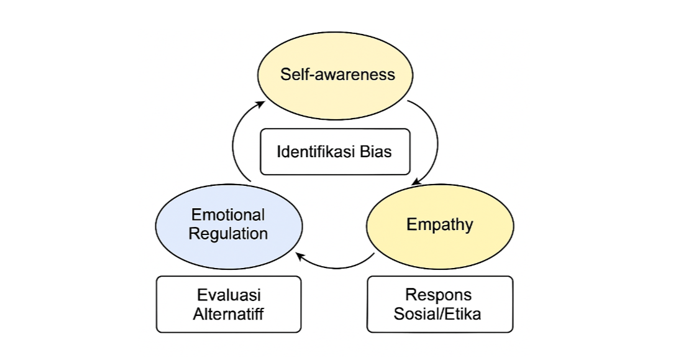
In today’s complex organizational environment, Emotional Intelligence (EI) plays a critical role in shaping the quality of economic decision-making by managers. This study investigates how the dimensions of EI—namely self-awareness, emotional regulation, and empathy—influence strategic decision processes across various industries. Using a descriptive qualitative approach with thematic analysis, data were gathered from semi-structured interviews with 10 senior managers, supported by observations and organizational documents. The findings reveal that EI serves as an internal mechanism that stabilizes cognitive processes under organizational pressure, reduces decision bias, and enhances the social legitimacy of economic decisions. The integration of EI fosters a balance between rational analysis and affective insight, leading to more ethical and adaptive decisions. This study offers an integrative model connecting EI dimensions with key stages of economic decision-making and provides practical implications for managerial training and organizational policy. It advocates for interdisciplinary approaches to better understand emotionally-informed economic behavior.
References
Al-Oweidat, I., Shosha, G. A., Baker, T. A., & Nashwan, A. J. (2023). The relationship between emotional intelligence and organizational commitment among nurses working in governmental hospitals in Jordan. BMC Nursing, 22(195), 1–12. https://doi.org/10.1186/s12912-023-01361-2.
Alzoubi, H. M., & Aziz, R. (2021). Does Emotional Intelligence Contribute to Quality of Strategic Decisions? The Mediating Role of Open Innovation. Journal of Open Innovation: Technology, Market, and Complexity, 7(2), 130. https://doi.org/10.3390/joitmc7020130.
Anand, N., Gorantla, V. R., Ranjan, R., & Morcos, H. (2023). Emotional intelligence: An important skill to learn now more than ever. F1000Research, 12, 1146. https://doi.org/10.12688/f1000research.134752.1.
Aref Abdulkarem Ali Alhashedi, B. B., Maged M. Mahyoub Al-Dubai, & Mohammed Abdulrazzaq Alaghbari. (2021). Organizational citizenship behavior role in mediating the effect of transformational leadership on organizational performance in gold industry of Saudi Arabia. Business: Theory and Practice, 22(1), 39–54. https://doi.org/10.3846/btp.2021.12774.
Berg, M., & Olsson, J. (2023). Managing public value conflicts – Institutional strategies and the greening of public pension funds. Scandinavian Journal of Management, 39(4), 101301. https://doi.org/10.1016/j.scaman.2023.101301.
Berthet, V. (2022). The Impact of Cognitive Biases on Professionals’ Decision-Making: A Review of Four Occupational Areas. Frontiers in Psychology, 12, 802439. https://doi.org/10.3389/fpsyg.2021.802439.
Blanco, I., Boemo, T., & Sanchez-Lopez, A. (2021). An Online Assessment to Evaluate the Role of Cognitive Biases and Emotion Regulation Strategies for Mental Health During the COVID-19 Lockdown of 2020: Structural Equation Modeling Study. JMIR Ment Health, 8(11), e30961. https://doi.org/10.2196/30961.
Brundin, E., & Languilaire, J. C. (2023). When the display of emotion is not enough: An emotion boundary management perspective on the quality of strategic decisions. Long Range Planning, 56(5), 102245. https://doi.org/10.1016/j.lrp.2022.102245.
Casaló, L. V., Flavián, C., & Ibáñez-Sánchez, S. (2021). Be creative, my friend! Engaging users on Instagram by promoting positive emotions. Journal of Business Research, 130, 416–425. https://doi.org/10.1016/j.jbusres.2020.02.014.
Chen, B. S., Yuan, C. H., Yin, B., & Wu, X. Z. (2021). Positive Emotions and Entrepreneurial Intention: The Mediating Role of Entrepreneurial Cognition. Frontiers in Psychology, 12, 760328. https://doi.org/10.3389/fpsyg.2021.760328.
Constantino, S. M., Schlüter, M., Weber, E. U., & Wijermans, N. (2021). Cognition and behavior in context: a framework and theories to explain natural resource use decisions in social-ecological systems. Sustainability Science, 16, 1651–1671. https://doi.org/10.1007/s11625-021-00989-w.
Cunha, M. P. e., Soares Leitão, M. J., Clegg, S., Hernández-Linares, R., Moasa, H., Randerson, K., & Rego, A. (2021). Cognition, emotion and action: persistent sources of parent–offspring paradoxes in the family business. Journal of Family Business Management, 12(4), 729–749. https://doi.org/10.1108/JFBM-11-2020-0104.
Deb, S. K., Nafi, S. M., Mallik, N., & Valeri, M. (2023). Mediating effect of emotional intelligence on the relationship between employee job satisfaction and firm performance of small business. European Business Review, 35(5), 624–651. https://doi.org/10.1108/EBR-12-2022-0249.
Doyle, J., Ojiako, U., Marshall, A., Dawson, I., & Brito, M. (2021). The anchoring heuristic and overconfidence bias among frontline employees in supply chain organizations. Production Planning and Control, 32(7), 549–566. https://doi.org/10.1080/09537287.2020.1744042.
Drigas, A., Papoutsi, C., & Skianis, C. (2023). Being an Emotionally Intelligent Leader through the Nine-Layer Model of Emotional Intelligence—The Supporting Role of New Technologies. Sustainability, 15(10), 8103. https://doi.org/10.3390/su15108103.
Estrada, M., Monferrer, D., Rodríguez, A., & Moliner, M. Á. (2021). Does Emotional Intelligence Influence Academic Performance? The Role of Compassion and Engagement in Education for Sustainable Development. Sustainability, 13(4), 1721. https://doi.org/10.3390/su13041721.
Jie, W., Poulova, P., Haider, S. A., & Sham, R. B. (2022). Impact of internet usage on consumer impulsive buying behavior of agriculture products: Moderating role of personality traits and emotional intelligence. Frontiers in Psychology, 13, 951103. https://doi.org/10.3389/fpsyg.2022.951103.
Kadeni, K. (2022). Pengaruh Kecerdasan Emosional Terhadap Kinerja Usaha Mikro Kecil dan Menengah (UMKM). Briliant: Jurnal Riset Dan Konseptual, 7(3), 615–623. https://doi.org/10.28926/briliant.v7i3.1019.
Kao, Y. F., & Venkatachalam, R. (2021). Human and Machine Learning. Computational Economics, 57, 889–909. https://doi.org/10.1007/s10614-018-9803-z.
Kumari, K., Abbas, J., Hwang, J., & Cioca, L. I. (2022). Does Servant Leadership Promote Emotional Intelligence and Organizational Citizenship Behavior among Employees? A Structural Analysis. Sustainability, 14(9), 5231. https://doi.org/10.3390/su14095231.
Lee, C. C., Li, Y. S., Yeh, W. C., & Yu, Z. (2022). The Effects of Leader Emotional Intelligence, Leadership Styles, Organizational Commitment, and Trust on Job Performance in the Real Estate Brokerage Industry. Frontiers in Psychology, 13, 881725. https://doi.org/10.3389/fpsyg.2022.881725.
Lee, C. C., Yeh, W. C., Yu, Z., & Lin, X. C. (2023). The relationships between leader emotional intelligence, transformational leadership, and transactional leadership and job performance: A mediator model of trust. Heliyon, 9(8), e18007. https://doi.org/10.1016/j.heliyon.2023.e18007.
Liu, H., & Boyatzis, R. E. (2021). Focusing on Resilience and Renewal From Stress: The Role of Emotional and Social Intelligence Competencies. Frontiers in Psychology, 12, 685829. https://doi.org/10.3389/fpsyg.2021.685829.
Maharaj, P., & Ramsaroop, A. (2022). Emotional intelligence as a contributor to enhancing educators’ quality of life in the COVID-19 era. Frontiers in Psychology, 13, 921343. https://doi.org/10.3389/fpsyg.2022.921343.
Majer, J. M., Barth, M., Zhang, H., van Treek, M., & Trötschel, R. (2021). Resolving Conflicts Between People and Over Time in the Transformation Toward Sustainability: A Framework of Interdependent Conflicts. Frontiers in Psychology, 12, 623757. https://doi.org/10.3389/fpsyg.2021.623757.
Mulya, F. (2025). Peran Kecerdasan Emosional dalam Kepemimpinan: Menumbuhkan Budaya Kerja yang Tangguh. Journal of Mandalika Literature, 6(1), 435–444. https://doi.org/10.36312/jml.v6i1.3851.
Naeem, M., Ozuem, W., Howell, K., & Ranfagni, S. (2023). A Step-by-Step Process of Thematic Analysis to Develop a Conceptual Model in Qualitative Research. International Journal of Qualitative Methods, 22, 1–18. https://doi.org/10.1177/16094069231205789.
Ran, Z., Gul, A., Akbar, A., Haider, S. A., Zeeshan, A., & Akbar, M. (2021). Role of Gender-Based Emotional Intelligence in Corporate Financial Decision-Making. Psychology Research and Behavior Management, 14, 2231–2244. https://doi.org/10.2147/PRBM.S335022.
Roni, F., Handoko, M., Parancika, R. B., Aris, M., Ardi, Y. M., & Syabrinildi. (2025). Determination of Employee Performance: Work Environment and Leadership Style : (Case Study at PT. MPIW Jakarta). Journal of Management and Informatics, 4(2), 773–790. https://doi.org/10.51903/JMI.V4I2.216.
Rosales-Pérez, A. M., Fernández-Gámez, M. A., Torroba-Díaz, M., & Molina-Gómez, J. (2021). A Study of the Emotional Intelligence and Personality Traits of University Finance Students. Education Sciences, 11(1), 25. https://doi.org/10.3390/educsci11010025.
Soriano-Vázquez, I., Cajachagua Castro, M., & Morales-García, W. C. (2023). Emotional intelligence as a predictor of job satisfaction: the mediating role of conflict management in nurses. Frontiers in Public Health, 11, 1249020. https://doi.org/10.3389/fpubh.2023.1249020.
Strugar Jelača, M., Bjekić, R., Berber, N., Aleksić, M., Slavić, A., & Marić, S. (2022). Impact of Managers’ Emotional Competencies on Organizational Performance. Sustainability, 14(14), 8800. https://doi.org/10.3390/su14148800.
Sulich, A., Sołoducho-Pelc, L., Ferasso, M., Raszkowski, A., Lewis, G. J., & Ishizaka, A. (2021). Management Styles and Decision-Making: Pro-Ecological Strategy Approach. Sustainability, 13(4), 1604. https://doi.org/10.3390/su13041604.
Supramaniam, S., & Singaravelloo, K. (2021). Impact of Emotional Intelligence on Organisational Performance: An Analysis in the Malaysian Public Administration. Administrative Sciences, 11(3), 76. https://doi.org/10.3390/admsci11030076.
Vrontis, D., El Chaarani, H., El Nemar, S., & Dib, H. (2021). The relationship between managers’ emotional intelligence and employees’ performance. Journal for International Business and Entrepreneurship Development, 13(2), 177–196. https://doi.org/10.1504/JIBED.2021.118270.
Vrtana, D., & Krizanova, A. (2023). The Power of Emotional Advertising Appeals: Examining Their Influence on Consumer Purchasing Behavior and Brand–Customer Relationship. Sustainability, 15(18), 13337. https://doi.org/10.3390/su151813337.
Zhao, X., & Stiles, D. R. (2023). Stuck in Limbo: how sensemaking discrepancy over strategy-related performance leads to disjointed collaboration in an international joint venture. Asia Pacific Journal of Management, 41, 903–945. https://doi.org/10.1007/s10490-023-09877-6.
Zhou, D., Peng, Z., & Zhou, H. (2023). The influence of career decision-making self-efficacy on employability of higher vocational students: mediated by emotional intelligence. Frontiers in Education, 8, 1274430. https://doi.org/10.3389/feduc.2023.1274430.
Downloads
Published
Issue
Section
License
Copyright (c) 2025 Iqlillah Nur Aida, Faishal Muhammad, Andi Dwi Anjani

This work is licensed under a Creative Commons Attribution-ShareAlike 4.0 International License.