Strategic Integration of Artificial Intelligence in Manufacturing Processes: Enhancing Sustainability and Efficiency
DOI:
https://doi.org/10.51903/e5v7qt70Keywords:
Artificial Intelligence, Manufacturing, Strategic Integration, Sustainability, Operational EfficiencyAbstract
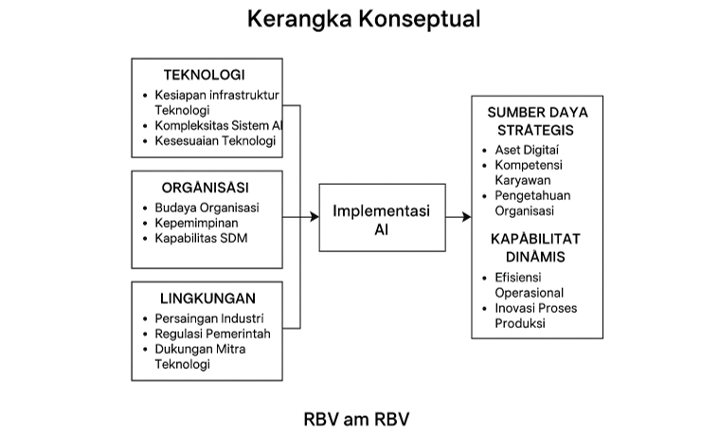
Digital transformation drives manufacturing companies to adopt artificial intelligence (AI) as a strategy to improve operational efficiency and competitiveness. However, the effectiveness of AI integration is influenced not only by technological readiness but also by internal organizational capabilities and external environmental pressures. This study aims to analyze how technological, organizational, and environmental factors contribute to the successful implementation of AI in the manufacturing sector, emphasizing the unique dynamics in developing countries such as Indonesia. This study uses a mixed methods approach with a sequential explanatory design. Quantitative data were collected through surveys of 85 respondents from various manufacturing companies in Indonesia, including operational managers, information technology managers, and professionals related to AI implementation. Analysis was conducted using PLS-SEM to test the relationships between variables. Subsequently, qualitative data were obtained through in-depth interviews with 10 key informants who have direct experience in AI planning and integration in their companies. The results show that organizational factors, especially managerial support and human resource competence, play the most significant role in driving the success of AI integration. Aspects of transformational leadership and work culture readiness also emerge as determining factors for the sustainability of adoption. This study expands the application of TOE and RBV theories in the context of developing countries and provides practical implications for the industry in formulating more adaptive and contextual technology adoption strategies.
References
Aijaz, N., Lan, H., Raza, T., Yaqub, M., Iqbal, R., & Pathan, M. S. (2025). Artificial intelligence in agriculture: Advancing crop productivity and sustainability. Journal of Agriculture and Food Research, 20(September 2024), 101762. https://doi.org/10.1016/j.jafr.2025.101762
Alam, M. C., Setiawan, B., Toiba, H., Maulidah, S., & Rahman, M. S. (2025). Supply chain management practices of SMEs in developing countries: Bibliometric and systematic reviews. Agricultural Economics (Czech Republic), 71(2), 99–112. https://doi.org/10.17221/290/2024-AGRICECON
Alfadhli, M., Onat, N. C., Kucukvar, M., & Al-Maadeed, S. (2025). Analyzing AI Readiness through Digital Transformation and Data Management: A Case Study of Qatar’s Government Sector. Applied Mathematics and Information Sciences, 19(3), 497–507. https://doi.org/10.18576/amis/190302
Aqmala, D., Panjaitan, R., Ardyan, E., Ibnu, F., & Sukono, F. (2025). The role of green blue ocean strategy in enhancing frugal innovation through IoT and AI : A resource-based view perspective. 21(2), 56–81.
Bolón-Canedo, V., Morán-Fernández, L., Cancela, B., & Alonso-Betanzos, A. (2024). A review of green artificial intelligence: Towards a more sustainable future. Neurocomputing, 599(May), 128096. https://doi.org/10.1016/j.neucom.2024.128096
Chen, K., Chen, X., Wang, Z. ao, & Zvarych, R. (2024). Does artificial intelligence promote common prosperity within enterprises? —Evidence from Chinese-listed companies in the service industry. Technological Forecasting and Social Change, 200(December 2023), 123180. https://doi.org/10.1016/j.techfore.2023.123180
Costa, F., Frecassetti, S., Rossini, M., & Portioli-Staudacher, A. (2023). Industry 4.0 digital technologies enhancing sustainability: Applications and barriers from the agricultural industry in an emerging economy. Journal of Cleaner Production, 408(December 2022), 137208. https://doi.org/10.1016/j.jclepro.2023.137208
Febriani, A., Sopha, B. M., & Arif Wibisono, M. (2025). Dynamic capabilities for omnichannel transformation in MSMEs: A comparative case study of fashion and furniture sectors. Journal of Open Innovation: Technology, Market, and Complexity, 11(1), 100498. https://doi.org/10.1016/j.joitmc.2025.100498
Khoa, B. Q., Toai, N. Van, Thi, D., Hien, T., Thuan, T. Q., Nguyen, H., Ba, D., & Anh, H. (2024). Influential factors of Artificial Intelligence ( AI ) in the digital transformation of the human resources recruitment process sector in Vietnam Article Info ISSN ( online ): 2582-7138 Volume : 05 Issue : 06 Received : 15-10-2024 Accepted : 16-11-2024 Page No : 1181-1193. 1181–1193.
Lin, Y., Yousaf, Z., Grigorescu, A., & Popovici, N. (2025). Harnessing digital foundations and artificial intelligence synergies: Unraveling the role of digital platforms, artificial intelligence, and strategic adaptability in organizational innovativeness. Journal of Innovation and Knowledge, 10(2), 100670. https://doi.org/10.1016/j.jik.2025.100670
Maruf, A. Al. (2025). American Journal of Interdisciplinary Studies A SYSTEMATIC REVIEW OF ERP-INTEGRATED DECISION SUPPORT SYSTEMS FOR FINANCIAL AND OPERATIONAL OPTIMIZATION IN GLOBAL RETAILS BUSINESS. 06(01), 236–262. https://doi.org/10.63125/qgbrmf24
Mitrache, M.-D., Spulbar, L.-F., & Mitrache, L.-A. (2024). The Influence of AI Technology in Stimulating Growth and Innovation in Business. Revista de Științe Politice. Revue Des Sciences Politiques • No, 81(81), 51–61.
Pesqueira, A., Sousa, M. J., & Pereira, R. (2025). Individual dynamic capabilities and artificial intelligence in health operations: Exploration of innovation diffusion. Intelligence-Based Medicine, 11(December 2024). https://doi.org/10.1016/j.ibmed.2025.100239
Plekhanov, D., Franke, H., & Netland, T. H. (2023). Digital transformation: A review and research agenda. European Management Journal, 41(6), 821–844. https://doi.org/10.1016/j.emj.2022.09.007
Purnamasari, R., Hasanudin, A. I., Zulfikar, R., & Yazid, H. (2024). Optimizing sustainable growth: Data, policies, and supply chains in Indonesia’s public sector. Social Sciences and Humanities Open, 10(July), 101104. https://doi.org/10.1016/j.ssaho.2024.101104
Radu, R. (2021). Steering the governance of artificial intelligence: national strategies in perspective. Policy and Society, 40(2), 178–193. https://doi.org/10.1080/14494035.2021.1929728
Raja, U. M., Haji, A., Margaretha, R., Syuzairi, M., & Mahadiansar, M. (2024). Center for Maritime Policy and Governance Studies Digital Transformation in the Maritime Industry; Opportunities and Challenges for Indonesia. 1, 1–10. http://cmpgs.umrah.ac.id/https://ojs.umrah.ac.id/index.php/jmps
Regona, M., Yigitcanlar, T., Hon, C., & Teo, M. (2024). Artificial intelligence and sustainable development goals: Systematic literature review of the construction industry. Sustainable Cities and Society, 108(May), 105499. https://doi.org/10.1016/j.scs.2024.105499
Saleh, M. A. S., & AlShafeey, M. (2025). Examining the synergies between industry 4.0 and sustainability dimensions using text mining, sentiment analysis, and association rules. Sustainable Futures, 9(July 2024), 100423. https://doi.org/10.1016/j.sftr.2024.100423
Sjödin, D., Parida, V., Palmié, M., & Wincent, J. (2021). How AI capabilities enable business model innovation: Scaling AI through co-evolutionary processes and feedback loops. Journal of Business Research, 134(April), 574–587. https://doi.org/10.1016/j.jbusres.2021.05.009
Sumarlin, T., & Qosidah, N. (2024). Optimizing Sales and Inventory Management with Machine Learning : Applications of Neural Networks and Random Forests. 3(2), 312–325.
Susanto, E., Holili, M. H., & Manalu, G. (2024). Supplier Relationship Management in the Digital Age : Enhancing Supply Chain Resilience Through Blockchain Technology. 3(3), 511–530.
Taghizadeh-Hesary, F. (2025). The impact of artificial intelligence adoption and financial accessibility on energy sustainability. Energy Strategy Reviews, 59(May), 101744. https://doi.org/10.1016/j.esr.2025.101744
Wibowo, A. (2024). JMI 04 (79-96) - (Bambang-Edy) TURNITIN.docx. 04.
Xuan, V. N. (2024). Determinants of environmental pollution: Evidence from Indonesia. Journal of Open Innovation: Technology, Market, and Complexity, 10(4), 100386. https://doi.org/10.1016/j.joitmc.2024.100386
Downloads
Published
Issue
Section
License
Copyright (c) 2025 Andi Gofur, Eko Satrio, Fajar Adji Wicaksono

This work is licensed under a Creative Commons Attribution-ShareAlike 4.0 International License.