Analysis of the Impact of Financial Literacy on Millennial Investment Behavior in the Digital Era
DOI:
https://doi.org/10.51903/bst98056Keywords:
Financial Literacy, Investemn Behavior, Millennials, Digital Era, FintechAbstract
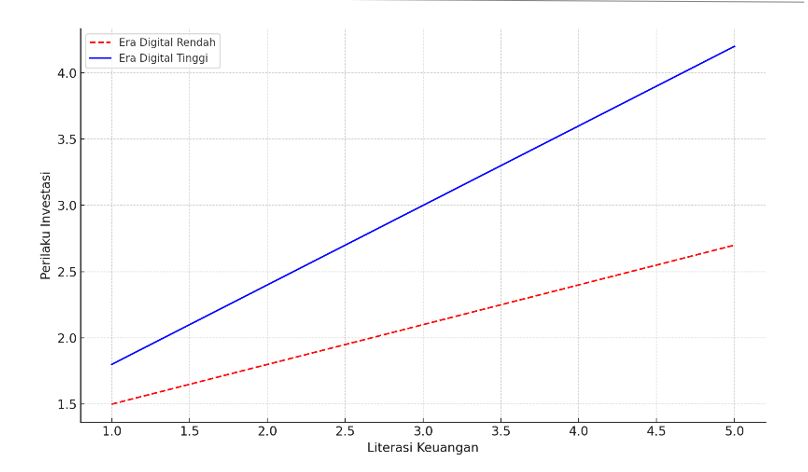
The rise of digital technology has influenced Indonesian millennials' financial behavior, especially in digital investment. However, wider access to financial products is not matched with adequate understanding, often leading to impulsive decisions. This highlights the gap between financial inclusion and financial literacy, making it crucial to study how literacy affects investment behavior in the digital era. This research examines how millennial financial literacy impacts investment behavior and how the digital environment moderates this effect. A quantitative method was used with data from 200 millennials engaged in digital investment, collected through an online questionnaire. Data were analyzed using multiple linear regression and moderated regression analysis (MRA). Results show that financial literacy significantly and positively influences investment behavior (p < 0.001). Moreover, the digital era strengthens this effect—active use of fintech and online communities amplifies the impact of financial literacy on rational investment choices. Financial literacy, investment behavior, and digital factors are interlinked. The study's findings are valuable for developing digital-based financial education and designing investment platforms that both guide and align with millennial traits.
References
Angrisani, M., Burke, J., Lusardi, A., & Mottola, G. (2023). The evolution of financial literacy over time and its predictive power for financial outcomes : evidence from longitudinal data. 640–657. https://doi.org/10.1017/S1474747222000154.
Aristei, D. (2025). Financial literacy , robo-advising , and the demand for human financial advice : Evidence from Italy.
Dambanemuya, H. K., & Wachs, J. (2023). Understanding (Ir)Rational Herding Online.
Delnoij, J., Rezaei, S., & Rijt, A. van de. (2023). Jump bidding does not reduce prices: Field-experimental evidence from online auctions. Journal of Economic Behavior and Organization, 209, 308–325. https://doi.org/10.1016/j.jebo.2023.03.010.
Friederich, F., Meyer, J. H., Matute, J., & Palau-Saumell, R. (2024). CRYPTO-MANIA: How fear-of-missing-out drives consumers’ (risky) investment decisions. Psychology and Marketing, 41(1), 102–117. https://doi.org/10.1002/mar.21906.
Grace Agusthine Ibadhi, & Leo Alexander Tambunan. (2022). Pengaruh Wfh (Work From Home) Dan Wfo (Work From Office) Terhadap Efektivitas Kinerja Karyawan Di Era Pandemi Covid-19. Jurnal Ilmiah Manajemen, Ekonomi Dan Bisnis, 1(1), 81–86. https://doi.org/10.51903/jimeb.v1i1.352.
Gustiarum, T., & Kusumawardhani, I. (2023). The effects of financial literacy, accounting information, risk perception and herding behavior on investment decision. Journal of Business and Information System (e-ISSN: 2685-2543), 5(1), 1–10. https://doi.org/10.36067/jbis.v5i1.156.
Hasselgren, B., Chrysoulas, C., Pitropakis, N., & Buchanan, W. J. (2023). Using Social Media & Sentiment Analysis to Make Investment Decisions. Future Internet, 15(1). https://doi.org/10.3390/fi15010005.
Hidayat, M. S., Muhammad, W., & Isdayanti, P. L. (2025). Digital Marketing Ethics in the Age of AI : A Comparative Analysis of Transparency and Consumer Trust in E-Commerce Platforms. 4(1), 723–740. https://doi.org/10.51903/jmi.v4i1.178.
Jiang, Z. (2023). Financial Literacy and Saving Behaviors of Households. Advances in Economics, Management and Political Sciences, 65(1), 99–110. https://doi.org/10.54254/2754-1169/65/20231603.
Katauke, T., Fukuda, S., Saidur, M., & Khan, R. (2023). Financial Literacy and Impulsivity : Evidence from Japan. 1–14..
Kuerzinger, L., & Stangor, P. (2024). The Relevance and Influence of Social Media Posts on Investment Decisions - an Experimental Approach Based on Tweets. SSRN Electronic Journal, 44(November), 101005. https://doi.org/10.2139/ssrn.4739088.
Kumar, S., & Chaurasia, A. (2024). The relationship between emotional biases and investment decisions: a meta-analysis. IIMT Journal of Management, 1(2), 171–185. https://doi.org/10.1108/iimtjm-03-2024-0034.
Long, T. Q., Morgan, P. J., & Yoshino, N. (2023). Financial literacy , behavioral traits , and ePayment adoption and usage in Japan. Financial Innovation. https://doi.org/10.1186/s40854-023-00504-3.
Long, T. Q., & Tue, N. D. (2024). Financial Knowledge and Short- and Long-Term Financial Behavior Across Gender and Generations: Evidence from Japan. SAGE Open, 14(4), 1–20. https://doi.org/10.1177/21582440241295846.
Mohanty, S., & Patnaik, B. C. M. (2023). Cognitive biases and financial decisions of potential investors during Covid-19 : an exploration. https://doi.org/10.1108/AGJSR-12-2022-0296.
OECD. (2024). Action needed to address gaps in financial literacy among students.
Ojo, M. O., Aguiar-Conraria, L., & Soares, M. J. (2024). The performance of OECD’s composite leading indicator. International Journal of Finance and Economics, 29(2), 2265–2277. https://doi.org/10.1002/ijfe.2784.
Olajide, O., Pandey, S., & Pandey, I. (2024). Social Media for Investment Advice and Financial Satisfaction: Does Generation Matter? Journal of Risk and Financial Management, 17(9), 410.
Otoritas Jasa Keuangan. (2025). Indeks Literasi dan Inklusi Keuangan Masyarakat Meningkat, OJK dan BPS Umumkan Hasil Survei Nasional Literasi Dan Inklusi Keuangan (SNLIK) Tahun 2025.
Peer, E., Journals, R., Publishers, B., Mahajan, S., & Kaur, R. (2025). The Dual-Edged Influence of Social Media in Financial Decisions. 5(2), 37–48.
Sriasih, S. D., Razak, F. A., & Ikhsan, H. (2025). AI-Driven Sentiment Analysis of Retail Investor Behavior during Market Volatility : A Study of Twitter Data in Southeast Asia. 4(1), 741–756. https://doi.org/10.51903/jmi.v4i1.179.
Srivastav, S. K., Habil, M., Thakur, P., Jain, J. K., & Saini, R. (2024). Analyzing the Influence of Fintech & Digitalization on Investment Choice Decisions of Mutual Fund Investors. International Journal of Research Publication and Reviews, 5(2), 2414–2415. https://doi.org/10.55248/gengpi.5.0224.0545.
Yanida, P., Padmanegara, O. H., & Muklis, T. I. (2024). The Intention to use Digital Investment Management Platforms Among Gen Z in Indonesia : Perspective from Individual and Technological Motives. 0(01), 17–30. https://doi.org/10.47191/jefms/v8.
Downloads
Published
Issue
Section
License
Copyright (c) 2025 Arham Bin Irham Nas, Udin Iksanudin, Iin Priany Poetri

This work is licensed under a Creative Commons Attribution-ShareAlike 4.0 International License.